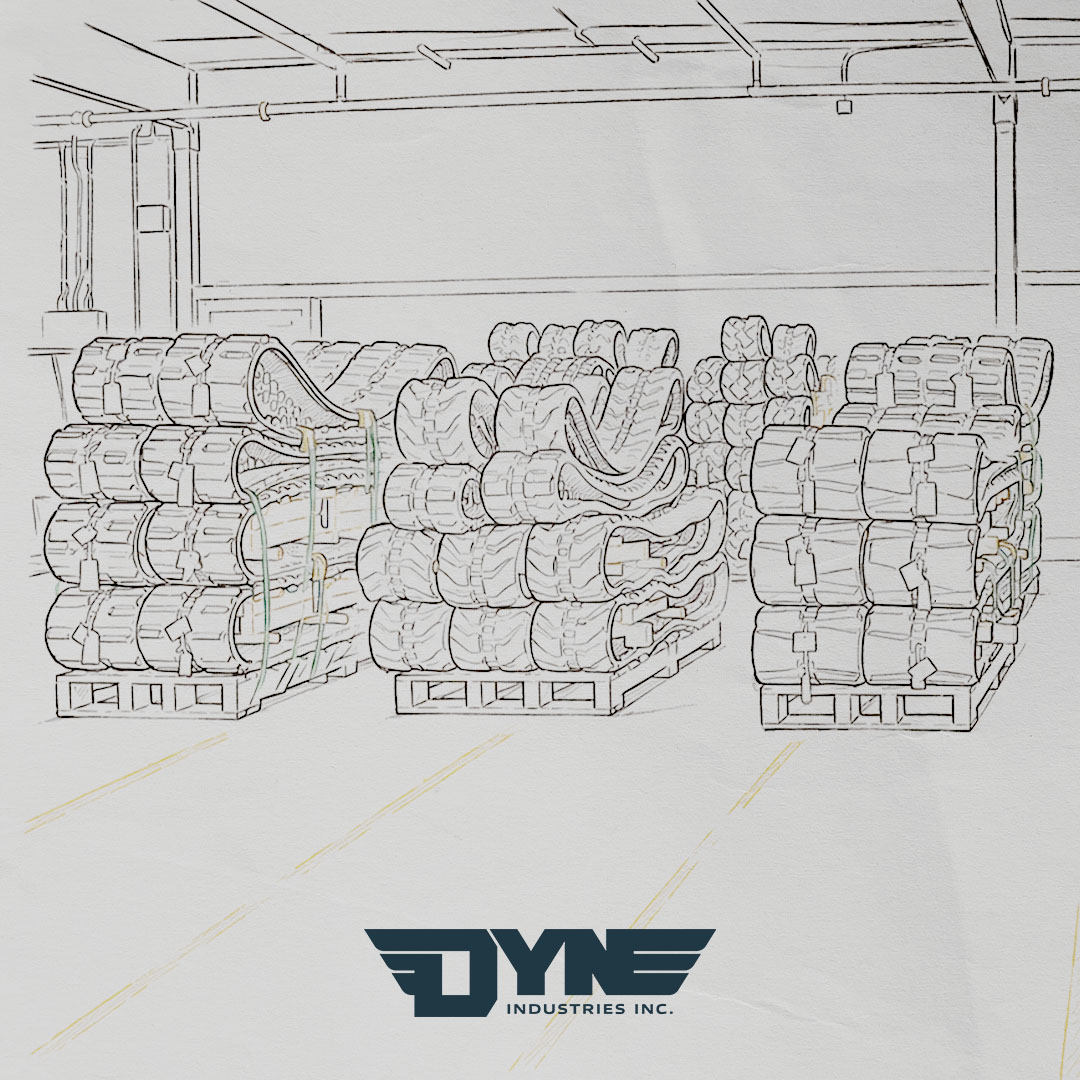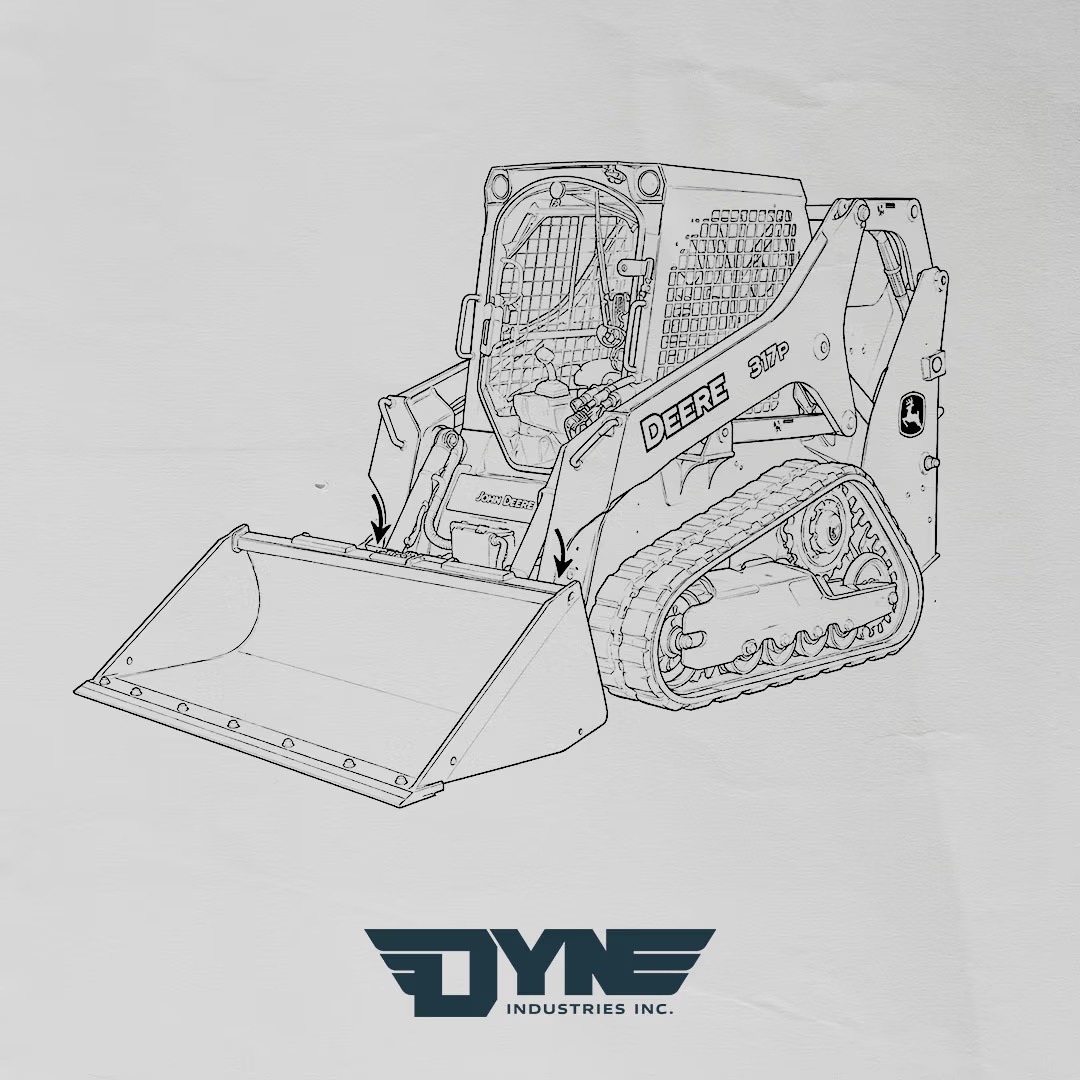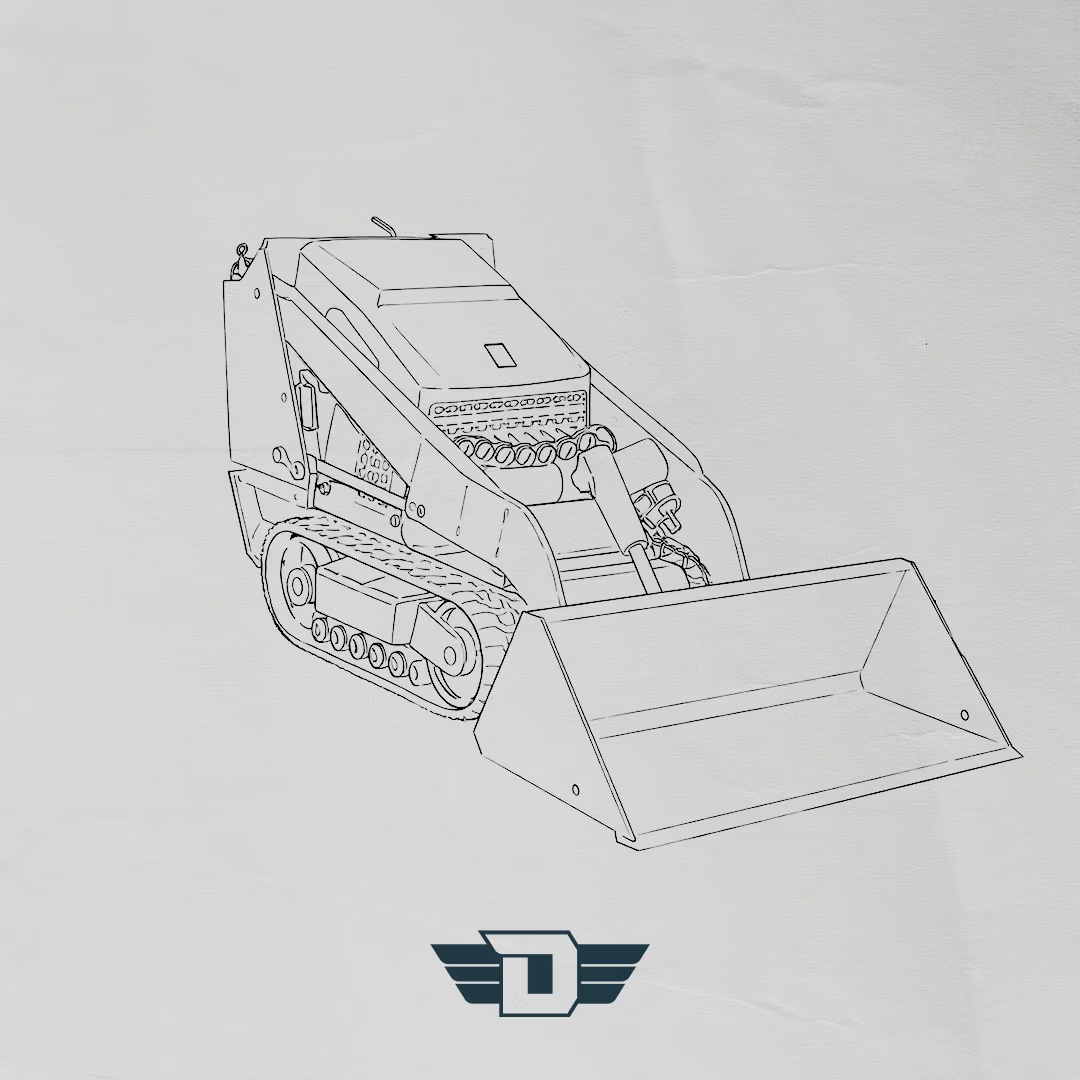


If you have been searching “Canada Tracks,” you are probably trying to solve a real problem, you need the right rubber tracks, and you need them fast.
In Canada, tracks take a beating. Spring breakup turns job sites into mud pits. Freeze thaw cycles crack hard ground into sharp edges. Summer gravel chews tread. Winter snow and ice push you to spin more, and spinning wears tracks quick.
When a track fails, your machine is down, your crew is waiting, and the clock is still running.
This guide is built to help you buy Canada tracks the smart way. We will break down what “Canada tracks” actually means, where to buy rubber tracks in Canada, how to confirm the right size (width, pitch, links), and what tread patterns work best for Canadian ground.
We will also cover pricing, supplier comparisons, and the common mistakes that lead to de-tracking, fast wear, and wasted money.
If you want the simplest path, Dyne Industries can help you, and they ship rubber tracks Canada-wide with warehouses in BC, Alberta, and Ontario.
You can search by make and model, request a quote, or build a wishlist so you can plan your replacement before downtime hits.
TL;DR
- Canada Tracks is usually shorthand for replacement rubber tracks for skid steers, CTLs, and mini excavators in Canadian conditions.
- Confirm fitment first, match width, pitch, and links, then double-check guide design so the track stays on.
- Pick tread based on your ground, zig-zag for mixed work, block for hardpack, aggressive lugs for mud, and plan for winter traction limits.
- Budget smart, price depends on size, build tier, and shipping, and cost-per-hour usually beats chasing the cheapest option.
- For fast fitment help and Canada-wide shipping, get your tracks from Dyne Industries Inc. using the Track Finder, request a quote, or build a wishlist.
Canada Tracks, what people mean and why it matters
If you have searched “Canada Tracks,” you are usually trying to solve one problem, you need the right track, fast, and you cannot afford a bad fit.
In Canada, tracks are not just a wear item. They are uptime. When a machine is down, the crew is waiting, and the job does not care that parts are backordered.
“Canada tracks” vs rubber tracks, track systems, and track parts
“Canada tracks” can mean a few different things.
Most of the time, people mean replacement rubber tracks for compact equipment, like mini excavators, compact track loaders (CTLs), and tracked skid steers.
Sometimes they mean track systems, like conversion kits that turn a wheeled machine into a tracked setup, or farm track systems for tractors and combines.
And sometimes they mean track parts, like rollers, idlers, and sprockets. If that is what you need, your local dealer or an undercarriage parts supplier is usually the right stop (Dyne Industries focuses on replacement rubber tracks).
Why Canada is tough on tracks (freeze thaw, mud season, rock, snow, road travel)
Canada beats up tracks in a few predictable ways.
Freeze thaw cycles turn hard ground into broken, sharp edges that chew tread. Mud season packs debris into the undercarriage, then dries like concrete. Rock and gravel cause cuts and chunking. Snow and ice reduce traction, so operators spin more, and spinning builds heat and wear.
Add in road travel or long trailer ramps, and you get extra abrasion that many people forget to factor in.
The real goal, reduce downtime and avoid buying the wrong track
The goal is not “buy tracks.” The goal is buy the right track once.
A wrong size, wrong guide, or wrong tread can derail (literally), waste hours, and damage rollers and sprockets.
In the next section, we will get practical about where to buy Canada tracks, and how to avoid the most common ordering mistakes.
Quick answer: Where to buy Canada tracks (rubber tracks) in Canada
If you want the clean answer, buy from a supplier who can confirm fitment, ship quickly, and support you when the jobsite gets messy.
That matters more than a flashy product photo or a low sticker price.
Best overall option for most buyers: Dyne Industries (nationwide shipping, track finder, support)
Dyne Industries helps Canadian contractors, operators, and fleet managers buy Canada tracks with fewer headaches.
The simplest path is: find your machine, confirm the exact track size and guide style, then ship Canada-wide to your yard or jobsite. If you are unsure, you can request a quote or build a wishlist and have a human double-check fitment.
Shop Rubber Tracks or Build Your Wishlist
Request a Quote
OEM dealer networks (when it makes sense, and when it is overpriced)
Dealers are a safe option when you need OEM-only parts, you want everything on one invoice, or you are already booking service.
The downside is price. OEM tracks can cost more, and lead times can still be rough in peak season. Dealer parts counters also vary, some are great, some are swamped.
Aftermarket track suppliers (what they do well, where buyers get burned)
Aftermarket suppliers can be the best value in Canada tracks, especially when you want solid quality without OEM pricing.
Where buyers get burned is fitment assumptions. A track can match the “three numbers” and still be wrong if the guide design or internal lug profile does not match your undercarriage.
Good aftermarket suppliers reduce that risk by confirming fitment, offering clear warranty terms, and having real support when you call.
Online stores and marketplaces (how to avoid compatibility mistakes)
Online stores are convenient, and that is why mistakes happen. To stay safe, do not order based on a blurry photo and a guessed model name. Confirm the exact make, model, and track size before you click buy.
If the listing cannot clearly explain the three key track measurements — width, pitch, and links — move on. These three numbers are the core of fitment:
- Width is the overall track width measured across the tread.
- Pitch is the distance from the center of one drive lug to the center of the next.
- Links is the total count of drive lugs around the inside of the track.
If these numbers are missing, you can measure your current track yourself:
- Measure width with a tape across the rubber surface.
- Measure pitch by placing the tape from the center of one lug to the next.
- Count total links around the inside of the track.
These measurements match how suppliers and OEMs list fitment specs, so you can then type them into search filters or ask the seller to confirm a match before ordering.
If you are buying tracks online, also look for a clear returns process and a real phone number so you can call and double-check fitment if needed.
Local heavy equipment parts counters (pros and cons by region)
Local parts counters can be great when you need same-day help, or you want to talk to someone who knows your region.
The tradeoff is selection. Many local counters stock common sizes, but harder-to-find tracks might still need to ship in.
The smart move is to use local service when speed matters, and use a Canada-wide supplier when you need better selection and fitment support.
Before we jump into choosing tracks, the next section will show a conversion-friendly way to shop Canada tracks through Dyne Industries without guessing.
Shop Canada tracks from Dyne Industries (put this early for conversion)
If you want Canada tracks without the back-and-forth, the best approach is simple, identify the machine, confirm the track, then get it shipped.
This section lays out the fast path most buyers use.
The simplest way to buy: search your make and model, confirm fitment, ship Canada-wide
Start with your machine make and model.
From there, confirm the track size and any OEM-specific guide details. Once it is confirmed, you can order or request a quote. This reduces the “close enough” problem that causes de-tracking and wasted time.
What Dyne needs from you to confirm the right track (make, model, year, serial if needed)
To confirm Canada tracks properly, you usually need:
- Make and model
- Year (or serial range, if the model changed over time)
- Current track size (if readable)
- Photos of the inside lugs and guide area (if you are unsure)
Some machines have optional track widths, or mid-run changes. When that happens, serial number ranges and photos are the fastest way to confirm the right fit.
If you already know your machine type, start here and narrow down fast.
Why buyers choose Dyne (inventory depth, warranty, human support, fast delivery)
Most buyers want the same things from Canada tracks.
They want the track to fit, last, and show up quickly. They want support if something is off, and they want warranty terms that are easy to understand.
The big difference is human support. When you are staring at a worn track with no readable numbers, a real fitment check saves you from ordering twice.
See Our Rubber Tracks FAQ page
Now that you know where to buy, the next step is making sure you choose the right Canada tracks for your machine and your jobsite.
How to choose the right Canada tracks for your machine
Choosing Canada tracks is not complicated, but it is easy to rush and get burned.
This section walks you through a simple process that works for contractors, farmers, and fleet teams.
Step 1, identify your machine and your work (construction, landscaping, snow, farm)
Start with what the machine does most days.
If you are running rock, demolition, or sharp fill, you need durability and cut resistance. If you are in mud and soft ground, you need bite and self-cleaning. If you are doing snow work, you need traction without tearing up the surface you are working on.
The same machine can need different Canada tracks depending on the season and the job.
Step 2, confirm the track size (Width x Pitch x Links)
Most rubber tracks use three numbers.
Width is how wide the track is. Pitch is the distance between lug centres on the inside. Links is the total count of those lugs around the track.
If you get these wrong, the track will not fit right, or it may fit and then de-track under load.
What the numbers mean, plain language
Think of width as “stance.” Wider can mean more flotation, but only if your machine is built for it.
Pitch is the spacing that matches your sprocket. Links is the total length of the track loop.
A simple measurement guide from TVH explains the same three-point method, width, pitch centre-to-centre, and total link count.
Example sizes and how to read them
A common format looks like 320 x 86 x 52.
That reads as 320 mm wide, 86 mm pitch, and 52 links. You may also see letters tied to tread patterns on some listings, but the core sizing is still the three numbers.
Step 3, measure your existing track if the numbers are worn off

If the numbers are gone, measure it.
Use a tape measure and take your time. The most common mistake is pitch. People measure edge-to-edge instead of centre-to-centre.
TVH and other track guides stress that pitch must be measured from the centre of one internal lug to the centre of the next.
Measure width correctly
Measure the width across the tread face, edge to edge.
If your tape is in inches, convert to mm (most track sizing is metric). Write it down and take a photo for your records.
Measure pitch center-to-center (most common mistake)
Flip to the inside of the track.
Measure from the centre of one drive lug to the centre of the next. Do not measure the gap, measure the lug centres.
That one detail prevents a lot of wrong orders.
Count links without losing your place
Count the internal lugs all the way around.
Mark one lug with chalk or tape, then count slowly. If you get interrupted, start again, it is faster than dealing with a wrong track.
Pro tip: why “close enough” sizes can still derail on some machines
Even if the three numbers match, guide design and lug shape can differ.
Some machines are picky about the guide height, guide width, or lug profile. A track that is “close” may run, but it can walk off during tight turns or side-slope work.
Step 4, confirm guide design and OEM-specific fitment (what changes between brands)
This is the part most people skip.
Guides keep the track centred on the rollers. If the guide is wrong, you can get de-tracking, abnormal wear, and rough travel.
A good supplier will confirm guide style for your exact machine model, especially if that model had optional track widths or mid-run changes.
Next, we will talk about tread patterns and track types, because Canadian conditions reward the right choice.
Track types and tread patterns for Canadian conditions
Canada tracks live on mixed terrain, often in the same day.
This section breaks down tread patterns in plain language, so you can match traction to your work instead of guessing.
Zig-zag tread, best all-around traction for mixed ground
Zig-zag is the common all-around tread.
It tends to track straight, grip well in mixed soil, and clean out reasonably in light mud. For many operators, it is the safest default when you do a bit of everything.
Block tread, stability and longer wear on hardpack
Block tread is often chosen for hardpack, gravel, and more finished surfaces.
It can feel stable under load, and it may wear more evenly if you do a lot of turning on firm ground. If you are constantly on sharp rock, you still need to watch for chunking.
C-lug and aggressive patterns, mud and soft ground bite
Aggressive patterns bite in mud, clay, and loose ground.
They can pull better in soft conditions, but they also can wear faster on hard surfaces if you do a lot of travel on gravel or pavement. Match the tread to your most common job, not your toughest day.
Snow and winter work, what actually helps (and what just spins)
Snow traction is not magic.
A more aggressive tread can help, but operator technique matters just as much. Gentle turns, controlled throttle, and avoiding long spins will keep you moving and protect your Canada tracks.
If you are constantly on ice, traction aids and proper job planning can matter more than changing tread.
Over-the-tire tracks (OTT) for wheeled skid steers, when they beat rubber tracks
OTT tracks are a different tool.
If you run a wheeled skid steer and need more bite in snow or mud, OTT can make sense. They also change ride feel and put different stress on the machine.
If you are deciding between OTT and rubber tracks, think about your machine type, your ground conditions, and how often you need that extra bite.
Now that you understand tread, let’s talk about OEM vs aftermarket Canada tracks, and how to avoid overpaying.
OEM vs aftermarket Canada tracks, how to choose without overpaying
A lot of people assume OEM is automatically “best.”
Sometimes it is. Sometimes it is just expensive.
This section will help you compare Canada tracks fairly, using questions that matter on a jobsite.
What “OEM spec” should mean, and what to ask a supplier
OEM spec should mean the track is built to match the fit and performance requirements of the original track.
Ask suppliers what that means in practice. Do they confirm guide design, not just the three numbers? Do they have a clear fitment process? Do they stand behind the order if something is off?
If they cannot answer that clearly, keep looking.
Where premium tracks earn their price (rubber compound, steel cord, lug bonding)
Premium tracks usually earn their price in consistency.
Better rubber compounds can resist cracking and chunking. Stronger internal cords and better bonding reduce the risk of lug tearing and stretch over time. Better builds can also help keep the track stable under heavy side loads.
These benefits show up on rough sites, frozen ground, and long travel days.
When aftermarket is the smarter buy (fleet standardization, faster shipping, better value)
Aftermarket makes sense when you need value, speed, and predictable support.
Fleet teams often standardize on a few proven track options that fit most of their machines. That simplifies purchasing and reduces downtime when a track fails.
Aftermarket also wins when you need Canada tracks fast and the OEM route is backordered.
Red flags of low-quality tracks (chunking, cracking, lug tearing, premature stretch)
Cheap tracks usually fail in familiar ways.
Chunking and tearing can happen when rubber quality is poor, or when the jobsite is brutal and the track is not built for it. Cracking can come from age, UV exposure, or lower-quality rubber. Lug tearing and premature stretch often show up when internal build quality is weak.
If you see multiple red flags early, it is often smarter to replace before you lose a day to a failure.
Next, we will compare supplier types in Canada, and show you how to choose the best supplier for your needs.
Best Canadian suppliers of rubber tracks, how to compare them fairly
Not all suppliers are equal, even if the tracks look similar online.
This section gives you a contractor-friendly way to compare suppliers, and avoid getting stuck with a track that does not fit.
The 7 questions to ask any supplier (fitment guarantee, warranty terms, returns, lead time)
Ask these seven questions before you buy Canada tracks:
- How do you confirm fitment for my exact make and model?
- What warranty coverage applies, and what does it exclude?
- What is your return policy if the track is unused?
- What is the lead time to my location in Canada?
- Do you offer support by phone if I am stuck mid-install?
- What happens if the track de-tracks right away?
- Can you help me choose a tread for my job conditions?
If a supplier cannot answer these cleanly, that is your warning sign.
What a “good warranty” looks like in real life (and what loopholes to watch for)
A good warranty is clear and practical.
Watch for vague language, hard-to-meet inspection requirements, or policies that make it nearly impossible to claim. Also watch for “wear item” loopholes that deny obvious defects.
The best warranties are paired with real support, because support is what saves you time.
Supplier types you will see in Canada
Most Canada tracks suppliers fall into a few buckets.
Each has pros and cons, and the right choice depends on your timeline and your risk tolerance.
Large national distributors (wide inventory, multiple warehouses)
These suppliers usually have broad coverage and faster shipping.
They can be a good choice for fleets and multi-province operations. The key is fitment support, because scale does not always mean accuracy.
Regional specialists (local knowledge, faster same-province delivery)
Regional suppliers often understand local conditions.
If you want same-province delivery or local pickup, they can be a strong option. Selection may be narrower, so uncommon sizes can take longer.
Online-first retailers (convenience, but fitment risk if support is weak)
Online-first sellers can be fast and convenient.
But if support is weak, you carry the risk. That is fine when you know your exact track size and guide style, and risky when you do not.
Other well-known suppliers buyers compare (and what to look for in each)
Contrax Equipment
Look for breadth of inventory, delivery options, and how clearly they confirm fitment.
Force Heavy Equipment
Look for support quality, warranty clarity, and how they handle wrong orders.
RubberTrackCanada (Astrak)
They list common track sizes and show clear examples of skid steer and CTL track pricing in Canada, which can help you sanity-check the market.
As always, confirm fitment beyond the three numbers.
TAG Equipment
TAG promotes OEM-spec replacement rubber tracks and support for major compact equipment brands.
Use the same process, confirm fitment, ask about lead time, and read warranty terms.
Why Dyne is positioned as the best choice for most Canadian buyers (service, coverage, speed)
For most buyers, Dyne fits the sweet spot.
You get Canada-wide shipping, fitment support, and a buying process built around real jobsite pressure. The goal is fewer wrong orders, less downtime, and a track that performs the way it should.
Here are a few names Canadian buyers commonly compare. Use the same 7 questions above for each one.
Next, we will narrow in on Edmonton and Western Canada buying, because season timing out west can make or break your schedule.
Rubber tracks Edmonton and Western Canada buying guide
Western Canada has its own rhythm, and it hits tracks hard.
If you buy Canada tracks in Alberta, BC, or Saskatchewan, timing and delivery options matter as much as tread choice.
What Edmonton buyers care about (shipping speed, jobsite delivery, support)
Edmonton buyers often care about one thing first, speed.
When spring hits, everybody is moving at once. If your track fails, you need a supplier who can confirm fitment quickly and ship without delays.
Jobsite delivery can also save time, especially if your machine is stuck on a remote site and you cannot easily pick up parts.
How to avoid ordering delays in peak season (spring breakup, summer rush, early winter)
Peak season is predictable.
Spring breakup and early summer are busy. Late summer can be a second wave. Early winter brings snow contracts and road work pressure.
The best way to avoid delays is to order before you are desperate. If you see cracking, chunking, or stretched tension that will not hold, start planning now.
Local pickup vs shipped tracks, what saves time and cost
Local pickup can be faster if inventory is nearby.
Shipped tracks can be faster if the supplier has stock ready and reliable freight. The real answer depends on where the track is sitting and how quickly it can move.
If downtime is costing you a crew day, the cheapest option is rarely the best option.
Next, we will talk about reviews, because “rubber track Canada reviews” can be helpful, but only if you know how to read them like a contractor.
Rubber track Canada reviews, how to read them like a contractor
Reviews can save you, or waste your time.
This section shows how to filter noise, spot useful signals, and avoid getting pulled into “best tracks” lists that do not match your work.
The review signals that matter (hours to failure, terrain, machine weight, maintenance habits)
The best reviews include context.
Look for terrain, machine type, load, and how the operator maintains tension. Hours-to-failure can be useful, but only if the reviewer describes how they work.
A track that fails early on sharp rock is not the same story as a track that fails early on soft dirt.
Common review patterns, what they actually mean (and what is user error)
Some bad reviews are real defects.
Others are sizing mistakes, wrong tension, or rough operating habits (tight pivot turns on dry pavement, constant spinning in place, running loose tracks in mud).
When you see a negative review, ask, “Is this a track problem, or a setup and use problem?”
Questions to ask before trusting a “best tracks” list
Before trusting a list, ask:
- Is the list trying to sell one brand only?
- Do they explain fitment process or just show products?
- Do they describe Canadian conditions, or generic use?
- Do they talk about warranty terms in plain language?
If the list avoids details, it is usually marketing, not guidance.
How to leave a useful review that helps other Canadian operators (simple template)
If you want to help other buyers, use this template:
- Machine make and model:
- Track size (width x pitch x links):
- Terrain and season:
- Typical load and attachments:
- Hours used before issues:
- Any maintenance habits (tension checks, cleaning):
- What you would do differently next time:
That kind of review helps the next person buy the right Canada tracks with confidence.
Next up is pricing, because you need a real-world way to budget tracks without guessing.
What is the average price of Canada tracks
Pricing for Canada tracks varies a lot, and that is normal.
This section gives you realistic ranges, explains what drives cost, and helps you justify the right buy to a fleet manager.
Typical price ranges by machine class (mini excavator, CTL, skid steer, agriculture)
Mini excavator rubber tracks are often in the mid-hundreds to low-thousands per track, depending on size and build tier. One Canadian parts retailer cites a common range of about $500 to $1,500 for mini excavator rubber tracks.
Skid steer and CTL tracks are often higher because they are wider, heavier, and take more abuse. Canadian retail listings commonly show many CTL sizes in the $1,200 to $2,000+ range per track, depending on size and tread.
Agriculture tracks can climb much higher because of size and application, especially on large track tractors and harvest equipment.
If you want the real number for your machine, the fastest move is to request a quote based on your exact make and model.
The biggest price drivers (size, build tier, tread, brand, shipping, promos)
A few factors move price quickly.
Bigger width and longer length cost more, every time. Build tier matters, premium tracks usually cost more because of materials and consistency. Shipping matters too, especially for remote delivery or fast freight.
Promos and multi-track discounts can help, but do not let a deal push you into the wrong track.
Should you replace one track or both (and when it is fine to do one)
Most of the time, replacing both tracks is the safer play.
You keep even traction and similar wear, and you reduce the chance of one new track fighting an older stretched track.
Replacing one track can be fine if the other track is still healthy, tension holds, and wear is truly similar. If the old track is near the end, doing one often turns into doing two, just with more downtime.
Cost-per-hour thinking, the easiest way to justify better tracks to a fleet manager
A simple cost-per-hour mindset helps.
If a cheaper track wears out early or de-tracks repeatedly, it costs you more in labour and lost production than the price difference you tried to save.
Better Canada tracks pay for themselves when they protect uptime, reduce failures, and keep crews moving.
Next, we will cover installation and maintenance, because a good track can still die early if tension and cleanup are ignored.
Installation and maintenance, get more hours from your tracks in Canada
Installing Canada tracks is not hard, but it is easy to rush.
This section covers break-in, tension basics, and simple checks that protect your investment through Canadian seasons.
New track break-in, what to do in the first 10 hours
Treat the first few hours like break-in.
Avoid hard pivot turns on dry ground. Re-check tension early. Look for any rubbing or guide issues before you put the machine back into full production.
A small check now can prevent a track walking off later.
Track tension basics (too tight vs too loose, and what damage each causes)
Tension is everything.
Too loose, and the track can de-track, wear sprockets faster, and slap the undercarriage. Too tight, and you can stress rollers, idlers, and the track itself, and heat builds up faster.
Always follow your machine manufacturer’s tension procedure. It is the safest baseline.
[External link: Your machine manufacturer operator manual -> URL placeholder]
Daily and weekly checks (rollers, sprockets, idlers, debris)
A quick walk-around saves money.
Clear packed mud and rocks when you can. Look for missing chunks, torn lugs, or cords showing. Watch for uneven wear.
If your undercarriage parts are worn, tracks will suffer. Dyne focuses on rubber tracks, so for rollers, idlers, and sprockets, your dealer or local undercarriage shop is usually the right supplier.
Winter realities (frozen mud, ice, road salt, storage tips)
Winter failures are often preventable.
Frozen mud is heavy and can jam the undercarriage. Ice can force the track to ride up and change tension. Road salt can speed up corrosion on metal components, and that affects how the track runs.
If you store equipment, keep tracks out of constant sun when possible, and avoid storing tracks under harsh tension for long periods.
How to keep your tracks from de-tracking on side slopes and tight turns
Side slopes and tight turns are prime de-tracking conditions.
Avoid aggressive pivot turns when the ground is dry and high-traction. Keep tension correct. Clean debris that can push guides out of alignment.
If de-tracking becomes frequent, it is often a fitment or undercarriage issue, not just “bad luck.”
Next, we will get into common problems and quick fixes, the save-the-day section that helps when you are mid-job.
Common problems and fixes
When Canada tracks start acting up, you need fast triage, not theory.
This section gives practical causes and checks you can do on site.
Track keeps walking off, the likely causes and quick checks
Start with the basics.
Check tension, and check for packed debris. Look for worn rollers or a damaged sprocket tooth pattern. Confirm the track is the correct size and guide style.
If the track is new and it walks off quickly, stop and confirm fitment before you burn up the undercarriage.
Chunking and tearing, when it is a track issue vs jobsite abuse
Chunking can be material, or it can be environment.
Sharp rock, demolition debris, rebar, and broken concrete will chew any rubber track. If chunking is severe and early under normal use, it may be a track build issue.
If chunking happens after hard abuse, a tougher tread or a different operating approach may be the answer.
Cracking, dry rot, and storage damage
Cracking often comes from age and exposure.
If a machine sits outside for long periods, rubber can dry out. If the track is very old, cracks can show up even if hours are low.
Storage matters. Shade and reasonable tension practices help.
Vibration and rough ride, when the undercarriage is the real problem
If the ride suddenly feels rough, do not blame the track first.
Check for missing lugs, but also check rollers and idlers. Flat spots and worn bearings can create vibration that feels like a track issue.
If undercarriage parts are worn, replacing tracks alone may not solve the problem.
When replacement is the only smart move (downtime math)
Sometimes the best fix is replacement.
If you are constantly stopping to re-tension, re-seat, or patch around problems, you are burning hours and risking bigger damage.
A new set of Canada tracks can be cheaper than one day of lost production, especially during peak season.
Next, we will talk about “made in Canada” questions, because buyers ask this a lot, and the answer needs nuance.
Rubber manufacturers in Canada and “made in Canada” reality check
Many people want Canada tracks that are “made in Canada.”
That is a fair question. The real answer depends on whether you mean replacement rubber tracks, or full track systems.
Track manufacturing vs track systems (what is actually made where)
Replacement rubber tracks for compact equipment are sold in Canada through many distributors, but manufacturing can be global.
Track systems are different. Track systems often involve more engineering, vehicle integration, and specialized production, and some of that work is done by Canadian companies.
The key is to focus on fitment, quality control, and supplier support, not just a label.
Soucy, Canadian track systems and custom solutions (who it is for)
Soucy is a well-known Canadian group in track systems, including custom track solutions for OEMs and specific industries.
This is usually not the route for a standard mini excavator replacement track. It is more relevant for specialized equipment, OEM projects, and larger system needs.
Camso and the Michelin connection (why it matters to buyers)
Camso has had a major Canadian footprint and has been closely tied to major global tire and track players.
Michelin completed its acquisition of Camso in 2018.
More recently, Michelin announced it was selling parts of its compact construction bias tires and tracks activities, including the Camso brand after a licensing period, to CEAT.
Why does this matter for buyers of Canada tracks? Brand ownership can shift, but what you care about day-to-day is whether the track you buy has consistent build quality, confirmed fitment, and real warranty support from the seller.
If you need a hard-to-find size, what “special order” really means (timelines, deposits, risk)
Hard-to-find sizes happen.
Special order usually means longer lead time, less flexibility on returns, and sometimes a deposit. It can be worth it, but you need to know the risks up front.
If you are in that situation, photos and serial information speed up confirmation and reduce mistakes.
Next, we will give you a copy-and-paste ordering checklist, so you can order Canada tracks without guesswork.
How to order Canada tracks without mistakes (copy, paste checklist)
Ordering errors are expensive, and they are preventable.
Use this checklist to keep your order clean, and to help a supplier confirm fitment fast.
Before you order: the 10 details to collect
Copy and paste this list:
- Machine make
- Machine model
- Year (or serial range)
- Current track size (width x pitch x links), if readable
- Any optional track width you know of
- Tread type you want (or your main terrain)
- Attachment and typical loads (bucket, mulcher, breaker)
- Shipping location (yard or jobsite)
- Your timeline (when the machine must be running)
- Photos of the inside lugs and undercarriage guide area
Photos that help a supplier confirm fitment fast (inside lugs, sprocket, undercarriage)
Photos beat long explanations.
Take clear photos of the inside lugs, the sprocket area, and how the track guides sit between rollers. If something looks worn or damaged, capture that too.
It helps a supplier flag problems before you waste time.
Questions to ask if your machine has optional track widths
Ask these:
- What track widths were offered for my model and year?
- Does my undercarriage match the narrow or wide setup?
- Will a wider track clear the frame and guide properly?
Optional widths are a common cause of “it should fit” orders that do not.
Best time to order to avoid downtime (season planning)
Order before you are desperate.
If you are heading into spring breakup or summer rush, plan track replacement like you plan oil changes, ahead of the failure.
A track that fails in peak season usually costs more than the track itself.
Next, we will wrap up the decision path, and give you a clear CTA to get the right Canada tracks.
Conclusion: Keep your machines moving, pick the right Canada tracks once
Canada tracks are not complicated, but they punish shortcuts.
If you follow a simple process, you will avoid the most common mistakes and protect your uptime.
Recap the decision path (machine, size, application, supplier, delivery)
Here is the clean path:
- Start with machine and work type.
- Confirm size (width x pitch x links).
- Confirm guide design for your exact model.
- Choose tread based on your terrain.
- Choose a supplier who confirms fitment and supports you after the sale. Then plan delivery around your season.
That is how you buy Canada tracks once, not twice.
Shop Dyne Industries rubber tracks, or call for fitment help
If you want Canada tracks with fewer headaches, start with Dyne.
Use the track finder, shop by machine type, or request a quote so fitment can be confirmed before you order.
FAQs
If you want fast answers, this section is built for that.
These are the questions people ask most when shopping Canada tracks, and the goal is to help you decide quickly without guessing.
The simplest place to buy rubber tracks in Canada is Dyne Industries Inc.
We help you confirm fitment (so you do not order the wrong size), then ship Canada-wide to your yard or jobsite. You can search by make and model with our Track Finder, request a quote, or build a wishlist if you are planning ahead.
“Canada tracks” is a broad search term.
Most of the time it means replacement rubber tracks for compact machines. Sometimes it means track systems or track parts, so it helps to clarify what you are actually shopping for.
Use your machine make and model, plus your track size.
If the size is not readable, measure width, pitch centre-to-centre, and count links, then have a supplier confirm fitment.
They are the track’s key dimensions.
Width is the track width in mm. Pitch is the spacing between internal lug centres. Links is the total count of those lugs around the track loop.
Yes, and it is straightforward.
Measure width across the tread. Measure pitch from lug centre to lug centre on the inside. Count total links around the track.
For most Canadian buyers, Dyne Industries Inc. is the best place to buy skid steer rubber tracks because we focus on getting fitment right the first time, then shipping fast across Canada.
You can search by make and model, confirm the correct width, pitch, and links with our team, and get clear warranty and support if anything comes up after delivery. This is the difference between “a track that should fit” and a track you can trust on the jobsite.
There are several well-known brands sold in Canada.
The practical approach is to choose a track built for your terrain and machine weight, then buy it from a supplier with strong fitment support and clear warranty terms.
Mini excavator rubber track prices vary by size and build tier.
A commonly cited market range is roughly $500 to $1,500 per track, but your exact model and size will move that number.
Usually both.
Replacing both keeps wear even and reduces the risk of one new track fighting an older stretched track. Replacing one can be fine if the other track is still in good shape and tension holds.
There is no perfect tread for ice.
A more aggressive tread can help in snow, but operator technique matters a lot. Avoid long spins, keep tension correct, and plan your work to reduce slipping.
Common causes include wrong tension, debris buildup, worn undercarriage components, and fitment issues.
If a new track de-tracks early, confirm size and guide design before continuing to run it.
It depends on terrain, maintenance, and operating style.
Rock, demolition debris, and lots of pivot turns shorten life. Regular tension checks and cleanup help you get more hours from your Canada tracks.
Keep Learning